Best Protein Sources Ranked by Quality (Not Just Quantity)
The label "30 g protein" on a food doesn't mean your body uses 30 g of protein. The actual amount your body absorbs, breaks down into amino acids, and uses to repair tissue is always less than the label — sometimes substantially. Protein quality scoring captures this.
The protein quality framework
Three measurements have been used historically:
- PDCAAS (Protein Digestibility Corrected Amino Acid Score) — older standard, capped at 1.0.
- DIAAS (Digestible Indispensable Amino Acid Score) — newer FAO-recommended standard, can exceed 1.0, more accurate.
- Net Protein Utilization (NPU) — older, simpler.
DIAAS is what current research uses. A DIAAS of 1.0 means 100 percent of the protein is bioavailable in usable form. Below 0.75, the protein source has limiting amino acids — usually lysine, methionine, or leucine.
The ranked list (DIAAS-based)
| Rank | Source | DIAAS (approx.) | Notes |
|---|---|---|---|
| 1 | Whey protein isolate | 1.10 | Gold standard. Fast-digesting, complete amino profile. |
| 2 | Whole milk | 1.18 | Surprisingly high; casein + whey blend. |
| 3 | Egg (whole) | 1.13 | Long-time reference standard. Complete profile. |
| 4 | Beef (lean) | 1.10 | Excellent profile, high in heme iron and B12. |
| 5 | Casein (slow protein) | 1.09 | Slow-digesting; ideal pre-bed. |
| 6 | Chicken breast | 1.08 | Industry default for cuts. |
| 7 | Fish (most species) | 1.00 | Generally complete protein. Highest in cod, salmon. |
| 8 | Pea protein isolate | 0.93 | Best plant isolate. Limiting in methionine. |
| 9 | Tofu / soy protein | 0.84–0.91 | Best whole-food plant protein. |
| 10 | Greek yogurt | 0.91 | Mostly casein with some whey. |
| 11 | Quinoa | 0.65 | Best whole-grain protein, but still incomplete. |
| 12 | Brown rice protein isolate | 0.61 | Weak alone, fine when blended with pea. |
| 13 | Beans (kidney, black, pinto) | 0.59 | Limiting in methionine. Combine with grains. |
| 14 | Lentils | 0.55 | Same as beans. |
| 15 | Wheat (gluten) | 0.54 | Limiting in lysine. |
| 16 | Almonds | 0.40 | Mostly fat with some protein; not a primary source. |
| 17 | Peanuts | 0.43 | Same — better as a fat/calorie source than a protein source. |
What "complete" and "incomplete" mean
A complete protein contains all nine essential amino acids — the ones your body cannot synthesize and must get from food — in proportions matching human needs.
Animal proteins (meat, fish, dairy, eggs) are essentially always complete. Most plant proteins are incomplete — usually low in lysine (grains, nuts) or methionine (legumes).
The classic plant-protein workaround: combine grains with legumes. Rice + beans, hummus + pita, lentils + naan. Together, they cover what each lacks individually. This doesn't have to happen in the same meal — your liver pools amino acids across meals — but daily diversity matters.
How quality interacts with quantity
The practical implication: plant-based eaters need slightly more total protein to achieve the same useful amino acid intake.
- Animal-based diet: 1.6 g/kg body weight is sufficient for most goals.
- Plant-based diet: 1.8–2.0 g/kg recommended to compensate for lower DIAAS scores and incomplete profiles.
For a 70 kg person:
- Animal-based: 112 g protein/day
- Plant-based: 126–140 g protein/day
Manageable on either, but the plant-based version requires more deliberate planning around protein density.
Leucine — the muscle-building trigger
Among the essential amino acids, leucine is the one that triggers muscle protein synthesis. The minimum effective dose per meal is 2.5–3 g of leucine (corresponding to roughly 25–30 g of high-quality protein in a single sitting).
Leucine content per 100 g:
- Whey isolate: ~10 g
- Beef: ~3.0 g
- Chicken: ~2.5 g
- Eggs: ~1.1 g (so 2 eggs = ~2.2 g — borderline)
- Greek yogurt: ~1.2 g per 100 g (so 250 g serving = 3 g — sufficient)
- Tofu: ~1.5 g
- Lentils: ~0.7 g
- Almonds: ~1.5 g per 100 g (but you eat far less than 100 g)
The implication: if you're plant-based and trying to build muscle, leucine is the leverage point. Add leucine-rich foods (tofu, soy, pea protein) to every meal, or add free leucine supplementation if you're optimizing for hypertrophy.
Practical hierarchy for different goals
Goal: weight loss + muscle preservation. Prioritize: whey isolate, egg whites, chicken breast, lean beef, white fish, Greek yogurt, cottage cheese. These are high DIAAS and high protein per calorie.
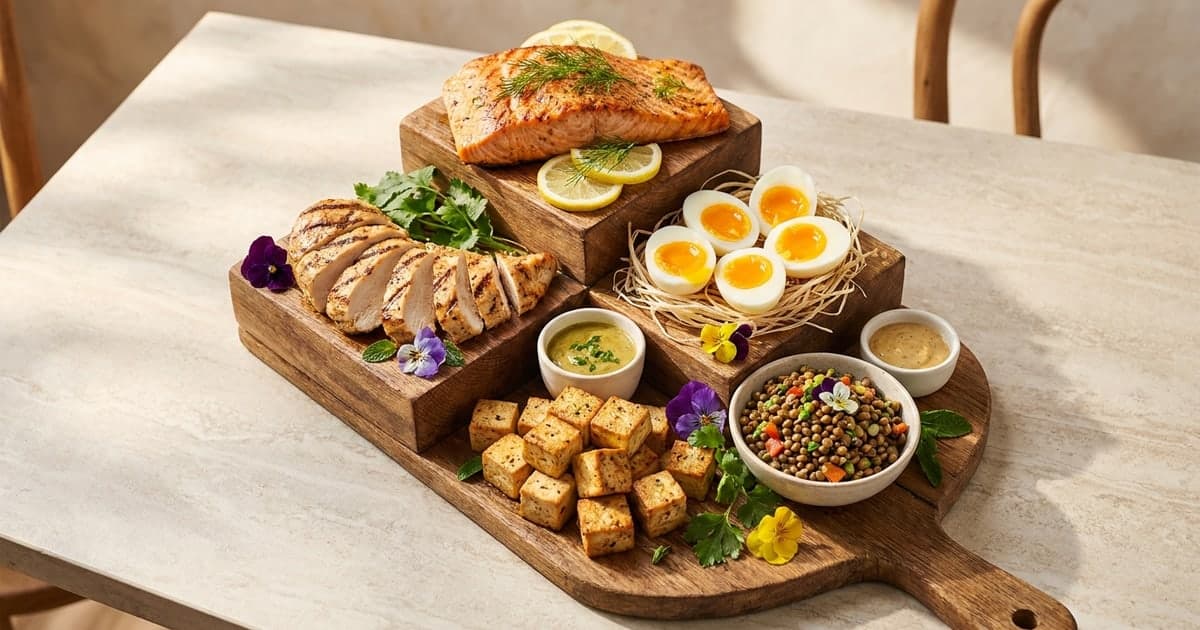
Goal: muscle gain. Same top tier plus additions: red meat (creatine + iron + B12), salmon (protein + omega-3), eggs (protein + nutrients in yolk), milk (whole), casein pre-bed.
Goal: general health, plant-leaning. Tofu, tempeh, soy milk, edamame, pea protein, legumes + grains in combination. Aim for the higher end of protein intake (1.8 g/kg).
Goal: budget protein. Eggs, canned tuna, milk, lentils, chicken thigh (not breast — cheaper, slightly higher DIAAS), peanut butter as a protein-fat blend.
Whey vs casein — when to use which
Both come from milk; they digest at different speeds.
- Whey is fast-digesting. Spikes amino acids in 30 minutes, falls within 2 hours. Best post-workout, when you want a fast hit of leucine.
- Casein is slow-digesting. Trickles amino acids over 4–6 hours. Best pre-bed, when you want overnight muscle protein synthesis.
For most people, one whey shake per day (post-workout or as a snack) and a high-protein dinner is sufficient. Casein supplements are mostly relevant if you're optimizing hypertrophy at the margin.
Plant-based protein powders
Plant protein powders have closed the gap on whey in recent years. Best options:
- Pea protein isolate — DIAAS ~0.93. Best single-source plant protein.
- Pea + brown rice blend — combination scores higher than either alone (pea covers rice's lysine gap; rice covers pea's methionine).
- Soy protein isolate — DIAAS ~0.91. Old school but well-studied.
- Hemp protein — lower DIAAS (~0.61), but higher fiber and omega-3.
Avoid single-source pea or rice if you're plant-based and optimizing hard. Blends or pea isolate are the default choices.
What to do this week
- Calculate your daily protein need: 1.6 g/kg if animal-based, 1.8 g/kg if plant-based.
- Hit at least 25–30 g of high-quality protein per main meal (3 meals = 75–90 g; the rest fills in via snacks).
- Anchor each meal with a top-10 source from the table above.
- Track protein for two weeks — most people undercount by 20 percent. Photo-AI trackers like Calzy auto-calculate protein per meal so you don't have to do it manually.
Quantity matters. Quality matters more than most people realize. Together, they're 80 percent of body composition outcomes — and the foods at the top of this list are how you hit both.
Ready to track smarter?
Snap a photo, get your calories, macros, and Health Score instantly. See what other trackers miss.
Download Calzy — It's Free