E-Numbers Explained: Which Food Additives Are Actually Safe?
The "E" in E-numbers stands for "Europe" — it is the labeling system that lets the EU regulate food additives. Every additive approved for use in EU food gets an E-number; the same additive can have a different name (and sometimes different status) in the US, Australia, or Japan.
The popular internet narrative is that E-numbers are inherently bad. The reality is more nuanced: most E-numbers are common, harmless ingredients. A handful are genuinely concerning, and a smaller subset are banned in certain countries. Below is the practical guide.
The categories
E-numbers are grouped by function:
- E100–E199: Colors
- E200–E299: Preservatives
- E300–E399: Antioxidants and acidity regulators
- E400–E499: Thickeners, stabilizers, emulsifiers
- E500–E599: Acidity regulators, anti-caking agents
- E600–E699: Flavor enhancers
- E900–E999: Sweeteners, glazing agents
- E1000–E1599: Additional additives (modified starches, etc.)
A food can list ten E-numbers and still be reasonable. A different food can list two and have a real problem. Numbers alone don't tell you the story.
Generally safe — common, well-studied additives
The following are widely consumed and have decades of safety data:
- E100 Curcumin — turmeric extract, natural yellow color
- E160a Beta-carotene — vitamin A precursor, natural orange color
- E162 Beetroot red — natural red color
- E300 Ascorbic acid — vitamin C, antioxidant
- E306 Tocopherols — vitamin E, antioxidant
- E322 Lecithins — emulsifier from soy or sunflower
- E330 Citric acid — common preservative, natural in citrus
- E331 Sodium citrate — pH regulator
- E407 Carrageenan — seaweed-derived thickener (some controversy in highly processed forms; broadly safe in food-grade)
- E440 Pectin — fiber from fruit, common in jams
- E412 Guar gum — fiber from guar bean
- E415 Xanthan gum — fermented carbohydrate, common in gluten-free baking
- E500 Sodium bicarbonate — baking soda
- E941 Nitrogen — gas, used in packaging
These are the additives a properly-fed researcher does not lose sleep over.
Use with awareness — common but not ideal at high doses
These are approved and not acutely harmful, but evidence suggests moderation:
- E150d Sulfite ammonia caramel — used in colas, found to form chemical compounds (4-MEI) classified as possibly carcinogenic at high doses by IARC.
- E211 Sodium benzoate — common preservative in soft drinks. Forms benzene when combined with vitamin C in acidic conditions; small amounts found in some sodas.
- E951 Aspartame — sweetener used in diet sodas. Classified as "possibly carcinogenic to humans" (Group 2B) by IARC in 2023, primarily from a controversial cohort study. Acceptable daily intake is set at 40 mg/kg body weight; you'd need to drink ~9 cans of diet soda per day for a 70 kg adult to exceed it.
- E621 Monosodium glutamate (MSG) — flavor enhancer. The "MSG sensitivity" of the 1980s has been largely debunked in placebo-controlled trials, but high doses cause headaches in some people.
- E110 Sunset yellow and E124 Cochineal red — food colors associated with hyperactivity in some children at high doses; warning labels required in the EU.
These are not poison. They are also not foods that should make up the majority of your diet.
Genuinely concerning — flagged or banned in some jurisdictions
These are the additives worth specifically avoiding when you can:
- E171 Titanium dioxide — white color, used in candy, gum, and pastry icing. Banned in EU food (2022) due to genotoxicity concerns. Still permitted in US food.
- E249 Potassium nitrite and E250 Sodium nitrite — preservatives in cured meats (bacon, hot dogs, ham). Form nitrosamines during cooking, classified as probably carcinogenic by IARC. WHO recommends limiting processed meat intake specifically because of these compounds.
- E251 Sodium nitrate and E252 Potassium nitrate — same family as nitrites, similar concerns.
- E319 Tert-butylhydroquinone (TBHQ) — synthetic antioxidant in fast food, processed snacks. Some animal studies show DNA damage at high doses; FDA limit is 0.02 percent of food weight.
- E102 Tartrazine — yellow color, restricted in some EU countries, requires hyperactivity warning label. Banned in Norway and Austria.
- E320 BHA and E321 BHT — synthetic antioxidants. Listed by the US National Toxicology Program as "reasonably anticipated to be human carcinogens" based on animal evidence.
- E635 Disodium 5'-ribonucleotides — flavor enhancer often paired with MSG. Triggers reactions in a small subset of sensitive individuals.
How to read a food label like a researcher
Three quick checks:
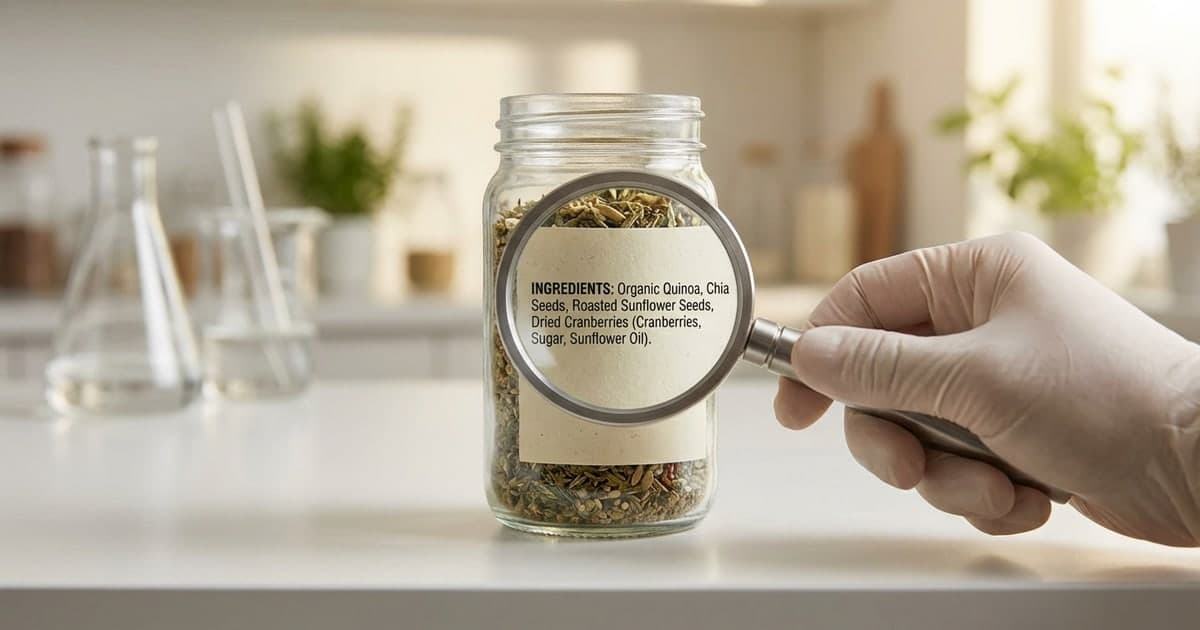
- Length of the ingredient list. Five or fewer recognizable items is a good sign. Twenty-plus is a red flag, especially when the ingredients are mostly E-numbers and chemical names.
- Position in the list. Ingredients are listed by weight. If sugar (or its synonyms — glucose-fructose syrup, dextrose, maltodextrin) is in the first three, the product is sugar-led.
- Concerning E-numbers. Scan for E171, E250, E319, E320/E321 — the "actually worry about it" set.
If a product clears all three checks, the additives in it are almost certainly fine. If it fails one or more, it's worth thinking about how often you eat it.
The processing-level shortcut
Most concerning additives are concentrated in ultra-processed foods — products that wouldn't exist without industrial chemistry: most packaged snacks, cured meats, soft drinks, ready meals, candy.
A simple rule that captures most of the additive issue: eat mostly minimally-processed food. Whole vegetables, whole grains, fresh meat and fish, dairy, eggs, beans, fruit, nuts. Limit ultra-processed food to roughly 20 percent of intake or less. The additive question largely solves itself.
A modern food tracker like Calzy automates this — it classifies meals by NOVA processing level (1: unprocessed, 4: ultra-processed) and flags 100+ concerning additives by E-number with severity ratings. You log the meal; the additive analysis is included.
What about "natural" additives?
The legal definition of "natural" is loose. Carmine (E120) is "natural" — it's made from crushed insects. Cochineal (E124) is also "natural." That doesn't make either inherently safer than synthetic alternatives.
A more useful frame: focus on the additive's actual safety profile, not its origin label. Beta-carotene (synthetic or natural) is fine; titanium dioxide is concerning whether it came from a mine or a lab.
What to do this week
- Pick three packaged products you eat regularly. Read the ingredient list. Look up any E-numbers you don't recognize.
- Identify the top one with the most concerning additives. Find a less-processed alternative for that product specifically.
- Use a tracker that flags additives automatically. Calzy detects 100+ concerning additives and shows their severity in every meal log.
The additive question is not "are they all bad" or "are they all fine." It is "which specific ones, in which doses, in foods I eat how often." Answer that and you've done 95 percent of the useful thinking.
Ready to track smarter?
Snap a photo, get your calories, macros, and Health Score instantly. See what other trackers miss.
Download Calzy — It's Free